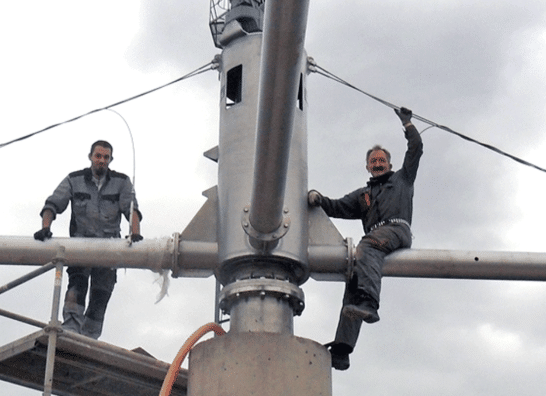
For 25 years, Patrick Dupré has put many things aside to devote himself fully to the development of FB Procédés. In his role as a company leader, he set himself a goal and had only one motto: satisfying customers by offering quality products. A true enthusiast who knew how to convey with undisguised pleasure the «suit-tie» look to convince buyers or engineers of the benefits of our products bar screens, in «work clothes» and installing a sprinkler or fixing a problem bar screen on site. A meeting with a key figure, who left the reins of FB Procédés the company to his son Guillaume in 2015.
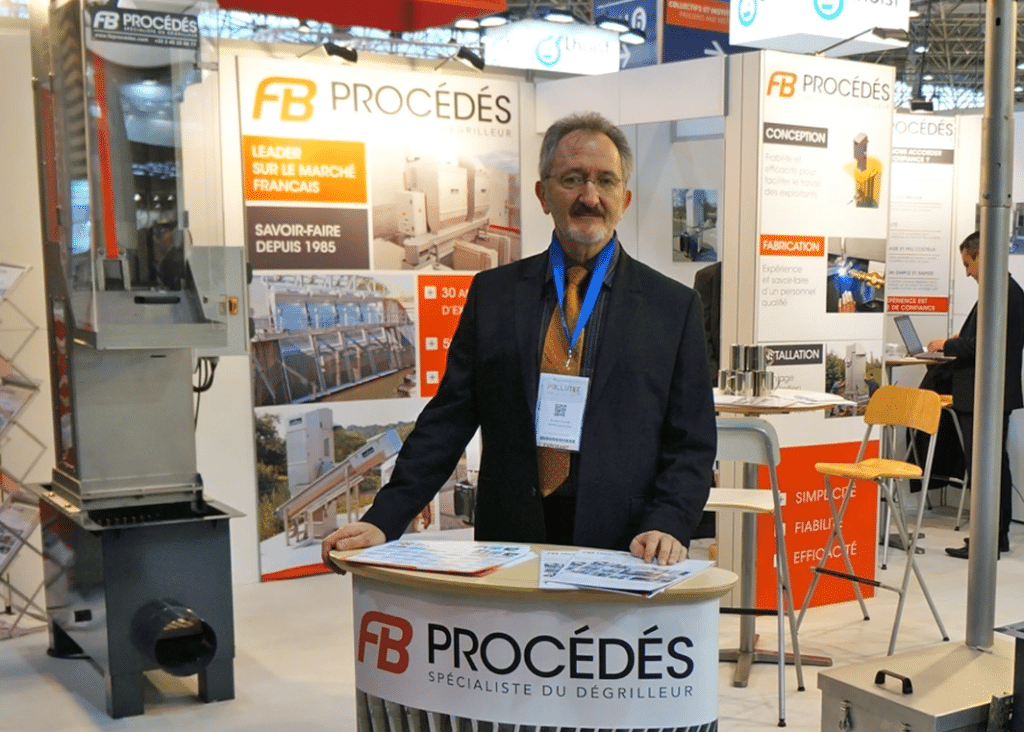
Hello Patrick. FB Procédés He is celebrating his 30th birthday these days. Since 1991, the company has grown considerably and has established itself in the sanitation industry. What inspires you about this?
In retrospect, I like to say that things happened like a puzzle. At one point, all the pieces came together to start this company, based on a brilliant product.
Success is, first and foremost, a collective achievement. I was fortunate to find the right people very quickly and to receive excellent support.
Then, having had the opportunity to hold trade shows. I spent a lot of energy organizing, participating in, and making the contacts obtained fruitful. The first one, at the end of 1992 (Pollutec Paris), was renting half of a booth with one of our neighbors from Nantes. We didn’t have any machines on the booth. I had, somewhat in a state of crisis, made a video cassette and printed some photos. We had a large «vertical bar screens automatic» display and a small FB Procédés «». At the time, we were very little known. This greatly contributed to getting our business off the ground.
And finally the idea of creating a bar screen model in 1996-1997 that was a bit more standard than the ones present at the time in our range. A model that bar screen could meet a maximum of needs. So we created the SG400.
So you arrived there FB Procédés in 1991. Tell us how that happened?
In 1989, I worked at WORTHINGTON Batignolles, a manufacturer of industrial pumps. They had lost nearly 30% of their employees and things weren’t going well. There was talk of relocation, unemployment, and layoffs. At the time, I played rugby at SNUC and I knew that Fernand Barré, whom I had known from a previous job, lived between my house and the stadium. Then one evening, coming out of a training session, I saw his wife and she told me that he had started designing and selling his own bar screens.
Then, the situation for WORTHINGTON did not improve and in 1990, I saw Fernand several times in the meantime.
And he therefore offered you to join him…?
Indeed, I was in a professional reorientation at the time. He did one bar screen a month. I remember his pile of files representing 4 years of activity. He worked at home and there was his drawing board, pins, cardboard to simulate the movements of the bar screen, his garden shed where he made flipping tests. And he told me: I would like someone to take over. We agreed that I could do something. Faced with competing technologies, he had explained to me well that he was convinced that there was something to be done. There was a market.
In that time, every time I had a serious opportunity for a job, there was always an event that prevented me from being hired. In retrospect, I realize that fate guided me towards what I was meant to be.
And what?…
Little by little, in the summer of 1990, during the memory of our past, I gave my consent. On the other hand, as part of my end of mission at WORTHINGTON, I had to go to Mans for two months to pass on the know-how. I even stayed two more months because the two initial months planned were too short. Moreover, they had offered me two other positions but I had already given my consent to Fernand.
During the social plan, for all creators or entrepreneurs, there was a bonus, professional evaluations and training. So I had a training to learn how to run a company. For 3 months, I learned a lot of things there.
Your adventure at commençait therefore FB Procédés began...
That’s exactly right. We worked at Fernand in a room where there was a drawing board and a desk. And when we received someone, a supplier or someone else, we would go to the café next door. We decided to launch the company on October 1st, 1991.
Fernand became a salaried employee and I became the minority shareholder. I was in charge of accounting and preparing the quotes. I also had to learn the dimensions and operation of the machines perfectly bar screens. For the quotes, I had bought an IBM ball-point typewriter. An extraordinary tool that served us for many years. It allowed us to produce quality documents for the time. We had a meticulous approach to detail and I think that’s one of the reasons why we became what we are today.
So you decided to accompany Fernand for two years until his retirement and then succeed him. But tell us how you met each other?
Since I graduated from school with my mechanical engineering degree, I had done a few small jobs and internships. In 1977, my wife was working as a management secretary in a company that rented offices to companies, offering services such as telex, photocopying, and reception—things that were expensive at the time. And among those companies was one with very nice guys called the SNEP, specializing in sewage treatment plants. They were looking for a draftsman. The head of the BE was a certain Fernand Barré. I applied and they hired me. Eventually, I answered the job offers and proposed two solutions: activated sludge and a bacterial bed. We had two days to put together our dossier. The job was exciting and I was happy every Monday to start the week. SNEP eventually filed for bankruptcy in June 1980.
Feeling the wind coming, I had started looking for another job and I responded to an advertisement for a method agent, which was my core business. And I was hired. I started on July 1st at WORTHINGTON Batignolles. I was responsible for repairing pumps, preparing quotes, prices, etc.
Did you have a proven aptitude for everything related to technique?
Yes. As a young boy, I tinkered with bicycles or Solexs. On the latter, I enjoyed disassembling the engine and taking it apart. I was also handed a nice set of mechanics by my father that dated from the Second World War. A look at bolted assemblies might seem insignificant, but when you’ve never touched a bolt in your life, it’s not just by looking that you understand things sometimes. This allowed me to use small motors and build things.
Otherwise, a little later, during the school holidays, I worked in a heavy-duty truck mechanic shop. I immersed myself in the world of mechanics.
I passed my baccalaureate and my driving license at the age of 18-19. I chose a short study program and opted for a DUT in mechanical engineering.
When you arrived at FB Procédés, and participated in trade shows, you must have also developed your commercial acumen…
That’s true, but at the end of my schooling, I had done a little work that made me aware of this point. I was a bit shy and reserved. I ended up selling postcards in Paris. I was a very bad salesperson. I sold only 7-8 packages a day, while my team leaders could sell up to 40 in half a day. They had extraordinary charisma and attitude. I didn’t have the temperament to sell anything to anyone. That’s not my thing, unlike what one might expect from a real salesperson. And then, the boss had the idea to create an agency in Nantes and he offered my two team leaders to manage this agency. I learned about it and offered to accompany them by suggesting that they teach me the job so that I could become a team leader in turn.
So we arrived in Nantes. They taught me how to hustle and recruit. By recruiting saleswomen, I also met the woman who would become my wife.
It was a real experience. Being a team leader, I had a blast and felt fulfilled.
How did your first years at the company go FB Procédés?
When I started with FB Procédés, all the lights were green and everything happened naturally.
One point I have always been committed to defending is the importance and respect of the customer internally. The customer is not the boss, but he is the wealth of the company. I also think that the image of the bar screen automatic watch has changed in the course of the 1990s, partly thanks to our technology. At that time, many of our colleagues offered much more complicated models.
In 1993, Fernand’s departure was an important moment in the life of the company because a replacement had to be found for him. This was a fundamental choice for a young company.
Absolutely. I thought of several acquaintances but it ended in rejection. Among them was Jean-Paul Planchot, who would eventually join our team later in 1998. But he reminded me by specifying that he might have someone who matched the position and he told me: it’s the son of Fernand Lobréau, the one you replaced at WORTHINGTON. The world is small.
So I met the great Robert, who had just been fired. We got along well and he worked with Fernand for a few weeks. He was super motivated, and he even made a mock-up of NI13 with a mechanic while he had just arrived. It was remarkable.
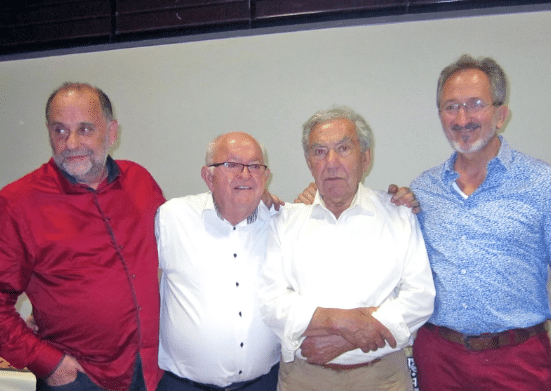
ROpen Lobréau, Claude Martin, Fernand Barré and Patrick Dupré
As Fernand Barré stated, the commercial pelote grew over the months, while satisfying the customers bar screens FB Procédés at the same time.
Success is also a story of encounters. For example, it was a certain Monsieur Rives who brought us into the Compagnie Générale des Eaux around Rennes. It was thanks to word of mouth that he became bar screen the best salesman. People had needs and started calling us, knowing our equipment. Little by little, that’s how we ended up joining the manufacturers of STEP because some operators began to express their preference for our products bar screens. I never rushed into making big commercial moves and let time take its course. Why go faster than the music? We were making progress slowly.
The evolution of a society usually involves taking risks, technological advancements or business that push the boundaries. Do you have any memories that come to mind about this topic?
Whatever the client’s request, I have never felt the need to take risks. It’s a matter of mindset. I undoubtedly took some risks, but they were part of a larger pattern. With the experience gained previously, it’s like a sixth sense. You either feel something or you don’t. When I decided on a technical evolution, for example, I knew I was right. This sometimes challenged our habitual way of working, but I felt it was essential. For example, I perceived, I think, quite well bar screen the boundary between fragility, robustness and superfluity. This is the culmination of field practice. I can tell you that when you spend many hours at the bottom of a canal repairing the railings, it’s a good experience and you learn quickly. Even better, you immediately know what you should no longer do.
At first, since there were only two or three of us, we regularly traveled to the site for various reasons. I took Robert on some pretty rough trips sometimes. Like the one to enlarge the holes on the 3 sprinklers in Annecy. All that to hear the operator say a few weeks later: «Mr. Dupré, that’s exactly what you did; it improves the yield, but it wasn’t necessarily useful.» But hey, that was my purist side; on machines that were a good laboratory for the future.
The design and launch of the SG400 are among the important milestones. It started off slowly, with a design that was a bit too simple, too lightweight, and we optimized it. We also increased its maximum length to meet customer needs.
There was also the bar screen de Livery event in La Baule. We had to use the levers and weights. We increased the weight of the cart at the top, and that became standard practice.
Another step, to be credited to Claude Martin. We were trying out one bar screen for a one-meter-wide salon in the workshop. The shape of the mobile support caused too much noise when opening the jaw. He said to me: «That piece could not be rounded instead of being straight?» Bingo, it became a standard.
You were talking about good people with whom you had been surrounded previously, and in that sense, your duo with Robert really boosted and carried the company for twenty years.
We complemented each other with Robert. He was more inclined not to reinvent the wheel with every project and therefore advocated maximum standardization. And I was more inclined to try to optimize each machine and customize it.
This allowed us to evolve and push our limits, starting from a width bar screen of 500mm, then 800mm, 1000mm, 1500mm and finally 2000mm. I think I must have been annoying at times for being picky about some of the details in the execution of some of the projects bar screens because for me, that was fundamental. As a designer, I was also a designer by design because I was faced with new challenges and behind that, it had to be reflected in the ranges, the profiles used, the sheet thicknesses… We formed a beautiful duo and we managed to diversify the material.