
The right gap is the smallest clearance that actually protects your downstream equipment without excessively increasing the load loss or the volume of rejects. Too wide, it lets through wipes and rags that clog the pumps and wrap around the agitators. Too narrow, it retains more waste, clogs more quickly and requires a wider bar Screen.
This choice comes first, even before the type of machine: it sets the width of the Bar Screen, the amount of screenings to remove and the reliability of the whole treatment line. Here is how to determine it.
What is the bar spacing of a Bar Screen?
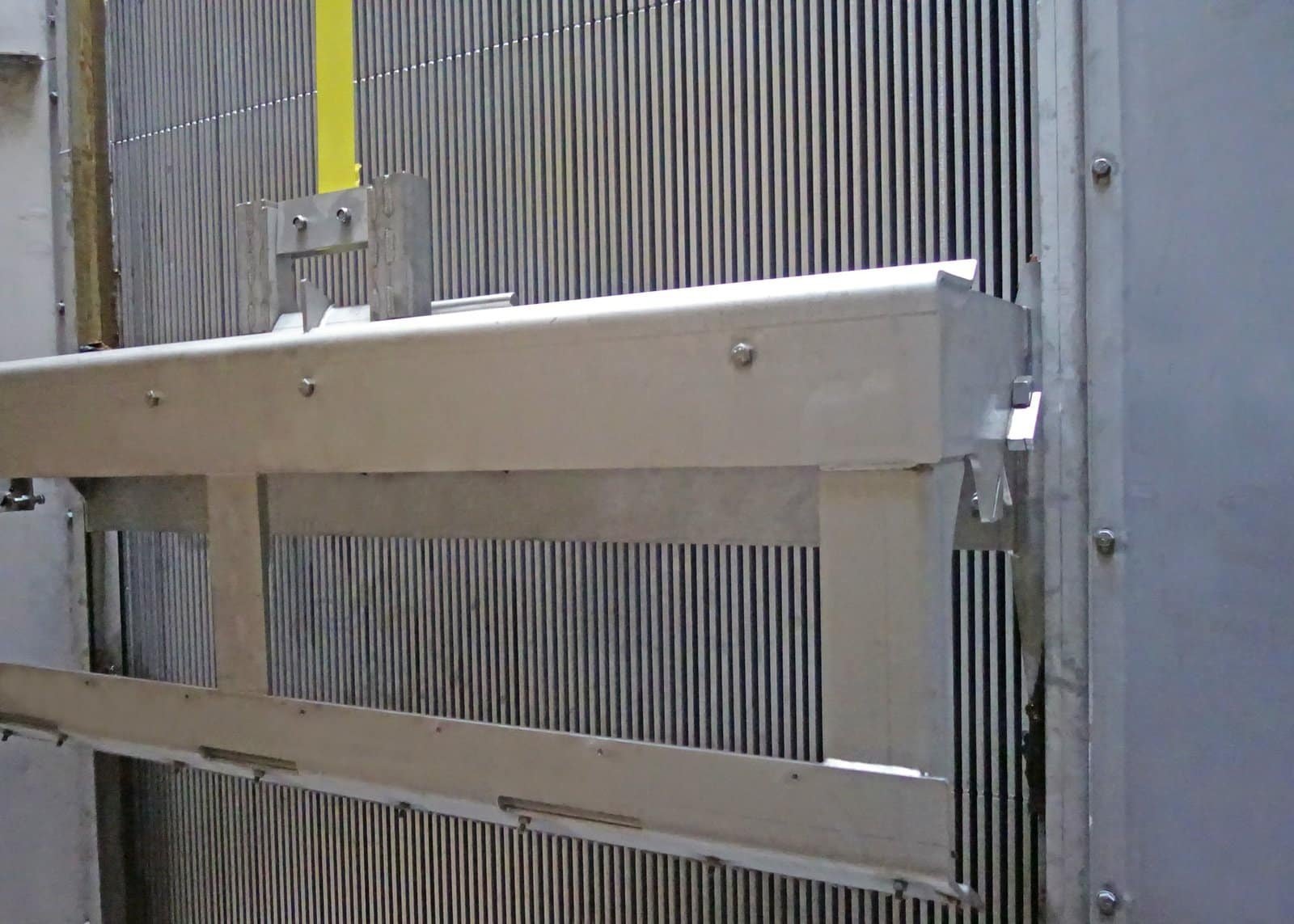
The bar spacing is the clear gap between two bars of the screen, measured in millimetres. It sets the size of the objects that are caught: anything wider than the gap is retained, then lifted out by the rake of the Bar Screen.
It should not be confused with the pitch of the screen, which runs from the centre of one bar to the centre of the next: pitch = bar spacing + bar thickness. A screen with 10 mm spacing and 6 mm bars therefore has a 16 mm pitch.
In practice, soft and elongated objects (wet wipes, fibres, plastics) sometimes slip through lengthwise, even when they are wider than the gap. This is why the spacing is chosen with a margin relative to the equipment to be protected.
Rough, medium or fine grating: the three levels of mesh
Screening is traditionally divided into three levels according to bar spacing. The values below are generally accepted orders of magnitude in wastewater treatment.
| Screening | Bar Spacing | Main role | Where it is used |
|---|---|---|---|
| Coarse | 30 to 100 mm | Stop with large objects (branches, rocks, etc.) | Pre-screening at the plant inlet, storm overflows |
| Medium | 10 to 25 mm | Protect pumps and structures from most debris | Pumping stations, stormwater, small treatment plants |
| Fine | 3 to 10 mm | Retain fibres, wet wipes and small debris | Treatment plant inlet, upstream of sieves or sensitive processes |
Below 3 mm, it is no longer called screening but sieving, using mesh or perforated-plate sieves.
Choosing the bar spacing by application
Choosing the slot according to the application
Wastewater treatment plant (municipal sewage) (urban wastewater)
At the plant inlet, the goal is to remove as many fibres and wet wipes as possible before the basins, mixers and recirculation pumps. Fine spacing, from 6 to 10 mm, is the standard. If the effluent carries large debris, wider pre-screening upstream prevents damage to the fine screen.
Pumping station
Here, the bar Screen protects the pumps. The gap must be significantly smaller than the free passage of the pumps, generally 10 to 20 mm. Vortex-wheel pumps or grinders (grinders that we do not recommend) tolerate waste better, but wipes remain the primary cause of clogging.
Stormwater and Storm Tanks
Flows are very high and debris is rather coarse: leaves, branches, plastics, street litter. Medium spacing, from 10 to 30 mm, handles large flows with a reasonably sized machine. When water is discharged to the natural environment, finer spacing limits visible pollution from floating litter.
Industrial wastewater
Everything depends on the process: food processing, paper mills, slaughterhouses or textiles produce very different waste. Spacing is chosen case by case, often fine, based on a sample or an analysis of the effluent.
Look first at what is downstream
The right question is not "which spacing?" but "what do I need to protect?". The bar spacing follows from the most sensitive equipment placed after the Bar Screen:
- Pumps : spacing well below their free passage, with a margin for soft debris.
- Mixers and aerators : fibres wrap around propellers; fine screening is required.
- Sieves, grit removal, membrane processes : they need an effluent already free of medium debris, so fine screening upstream.
- • Discharge to the environment : the spacing directly determines the litter that ends up in the river.
Simple rule: if a downstream unit has already been clogged by debris, the current spacing is probably too wide for it.
What finer spacing changes
Reducing the spacing improves protection, but has three consequences to plan for from the sizing stage.
1. A wider screen for the same flow
With bars of the same thickness, the smaller the gap, the larger the share of steel in the cross-section and the less room the water has to flow. The open-area ratio is:
where e is the bar spacing and b the bar thickness. With 6 mm bars, it drops from about 77% for 20 mm spacing to 62% for 10 mm and 50% for 6 mm. To keep a reasonable velocity between the bars, around 0.6 to 1 m/s, a wider Bar Screen or a deeper channel is needed.
2. More head loss
A finer screen traps more water and clogs more quickly between two cleanings. The level rises upstream: it must be checked that it remains below the overflow level of the channel, at the peak flow rate and with the screen partially clogged. The frequency of cleaning of the bar Screen is adjusted accordingly, sometimes controlled by a differential level sensor.
3. More screenings to remove
The volume of retained waste rises sharply as the spacing decreases. Orders of magnitude for municipal wastewater:
| Screening | Screenings volume |
|---|---|
| Coarse (30 to 100 mm) | 2 to 5 litres per inhabitant per year |
| Medium (10 to 25 mm) | 5 to 10 litres per inhabitant per year |
| Fine (3 to 10 mm) | 10 to 25 litres per inhabitant per year |
These refusals are wet and smelly: a compacting vise When removed from the bar Screen, they reduce their volume and facilitate their removal.
Common mistakes
- • Choosing the finest spacing "to be safe" without adapting the width of the Bar Screen: the screen blinds, the channel overflows and the effluent bypasses the screen untreated.
- • Keeping the spacing of the old machine during a replacement, when the effluent has changed. The massive influx of towels Many de-glazing operations of 20 to 30 mm have been rendered insufficient.
- • Forgetting screenings handling : fine screening without compaction or suitable disposal quickly becomes an operating burden.
- rather than peak flow, especially on combined sewers that also carry rainwater. rather than at peak flow, especially on unitary networks that receive rainwater.
Frequently asked questions
What is the standard bar spacing for a treatment plant Bar Screen?
At the inlet of a municipal wastewater treatment plant, 6 to 10 mm spacing is the most common. It retains most fibres and wet wipes while keeping head loss under control.
Can the bar spacing of an existing Bar Screen be changed?
Can the bar spacing of an existing Bar Screen be changed?
What is the difference between a Bar Screen and a sieve?
A bar Screen uses a bar grating with a gap of about 6 mm. A sieve uses a mesh or perforated sheet for finer openings. A sieve often complements a bar Screen; it is rarely used in place of it.
Does finer spacing cost more?
For the same flow, yes: the screen must be wider, and the larger volume of screenings requires suitable compaction and disposal. But it prevents pump failures and unblocking call-outs, which are often far more costly over time.
Planning a screening project?
Since 1985, FB Procédés has designed and manufactured custom stainless steel automatic Bar Screens, adapted to every channel and every effluent. Our engineers help you choose the bar spacing and size the machine based on your peak flow and the layout of your structure.